
Animal welfare education in Rajasthan: what 24,246 children taught us about fear and kindness
This is a guest post by Help in Suffering, an animal welfare NGO based in Jaipur, Rajasthan.
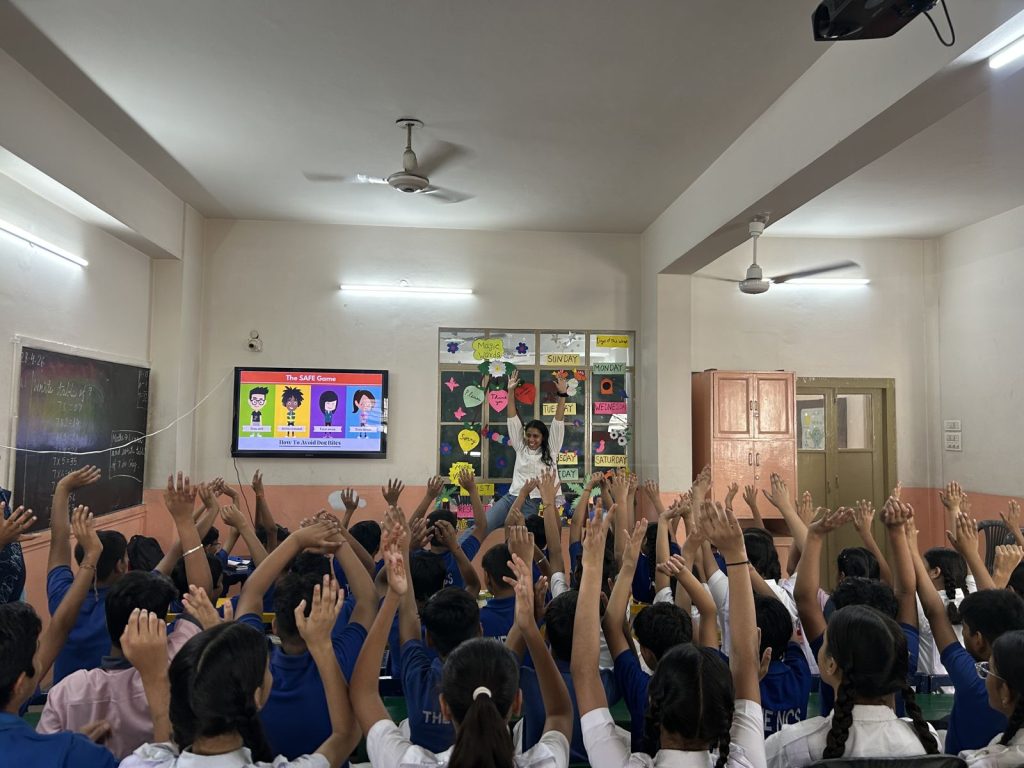
On a busy morning in a government school in Jaipur, a facilitator asks a room of thirty children a simple question: “Have you ever seen an animal that needed help?”
Almost every hand goes up.
Then comes the second question: “Did you help?”
The hands come down. Slowly. One by one.
Not because these children are unkind. But because most of them were afraid. Afraid of the dog lying by the roadside. Afraid of getting bitten. Afraid of doing the wrong thing. Afraid, in some cases, simply of getting close.
This moment, the gap between wanting to help and knowing how, is what the A World For All Humane Education Programme was built to close.
Table of Contents
The problem we were solving with animal welfare education
Help in Suffering has operated in Jaipur since 1980. Over four and a half decades, we have rescued and treated more than 200,000 animals, sterilised over 105,000 street dogs under our Animal Birth Control programme, and run one of the largest camel welfare operations in India.
We know how to treat an injured animal. What took us longer to understand is this: the most durable form of animal welfare is not rescue. It is attitude change.
Every dog we treat goes back to a street where people live. Every camel we heal returns to a handler who may or may not know how to care for it humanely. Every stray cat we sterilise lives in a neighbourhood where children grow up deciding, day by day, whether to be kind or cruel and often making that choice not out of malice but out of ignorance and fear.
Fear is something we believe deserves much more attention in animal welfare. In our experience, fear and lack of understanding can contribute significantly to harmful interactions between people and animals. Children who fear street dogs throw stones at them. Children who don’t understand that a cow eating plastic will suffer and die keep offering her food scraps wrapped in polythene. Children who have never been taught that a dog’s lowered ears and tucked tail means “I am afraid” have no way to know that the approaching, growling animal they’ve panicked is reacting to their own panic.
Animal welfare education doesn’t just make children kinder. It makes communities safer.
What we built and why we built it the way we did
The A World For All curriculum is a six-lesson animal welfare education programme for children aged five to seventeen, designed for delivery in Indian government and private schools. It is bilingual, structured, and built from the ground up for the Indian classroom.
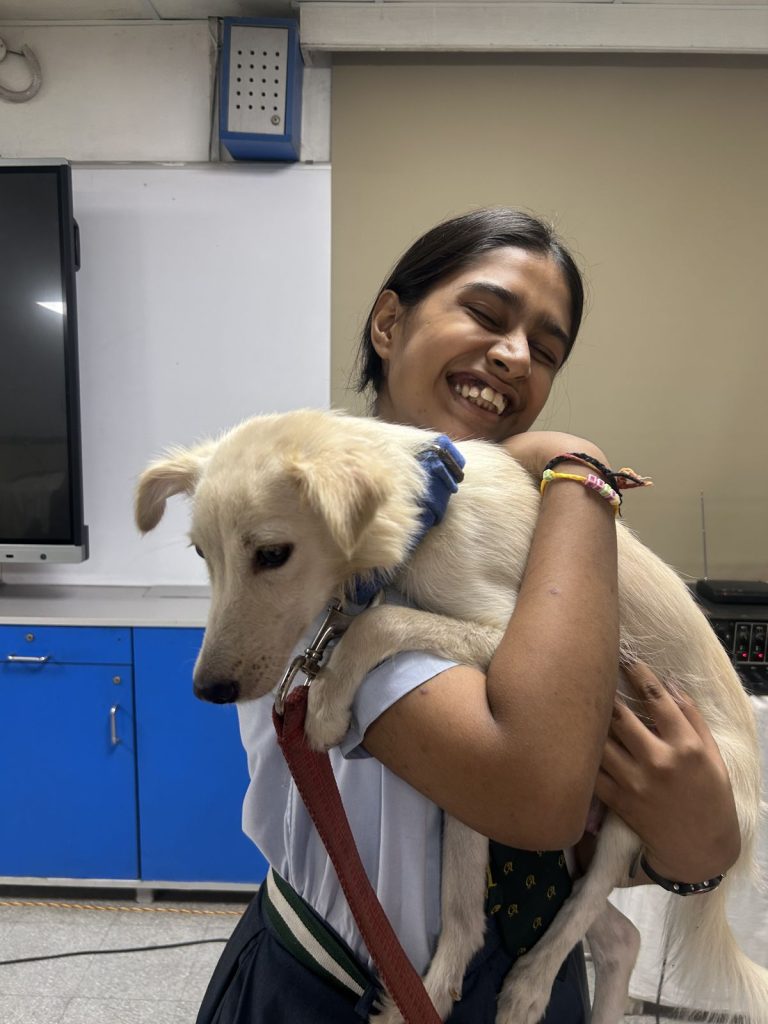
Each lesson builds on the last. Children begin by meeting Kali, a real dog from our shelter, found paralysed on the streets of Jaipur’s VKI Industrial Area, now living in permanent care at our facility. Her story opens the first session, and the facilitator’s first question to the class is not about animals at all: “Has someone ever helped you when you were scared and in pain? How did that feel?”
From empathy for Kali, children move to understanding animal body language, learning to read a wagging tail from a stiff one, a relaxed dog from a fearful one. They learn the Five Freedoms of animal welfare. They learn what to feed a street dog (and why sweets and spicy food cause real harm, despite the kindness behind them). They learn what rabies is, how it spreads, and precisely what to do in the fifteen minutes after an animal bite, knowledge that is still not universally taught despite rabies remaining entirely preventable.
The final lesson asks children to act: to make a Kindness List, run a Rescue Role-Play, or build an Animal Club in their school. The programme is designed so that the last session is not the end but the beginning of something.
What the data tells us, and what it doesn’t
After every session, children complete a pre- and post-assessment worksheet. These figures are based on pre- and post-session assessments conducted as part of the programme. The numbers we have gathered across 116 schools and 24,246 children are, by any measure, significant:
– 97.8% knowledge retention across post-session assessments
– 52% reduction in fear of animals among participating children
– 61% increase in rabies awareness
– 52% increase in animal welfare knowledge
But statistics don’t capture what actually happens in a classroom. They don’t capture the child who raises their hand to say they had always been told that street dogs were dangerous and dirty, and who, after the session on animal behaviour, went home and put a bowl of water outside their building for the first time. They don’t capture the teacher who asked if the programme could come back, not for the students, but because she had learned something too.
“The workshop was very helpful for the students. They really enjoyed the session and learnt about dogs and other animals. The storytelling sessions were expressive and engaging.”
Dr. Shekhar Kapoor, Principal, Sunny Academy, Jaipur
We do not claim that a ninety-minute animal welfare education session transforms a child’s entire relationship with the living world. What we do claim, and what the data supports, is that it shifts the starting point. It gives children a vocabulary for what they are already feeling, a framework for what they don’t yet know, and permission to act on the kindness that, in almost every classroom we have entered, was already there.
Why animal welfare education matters now
In 2026–27, CBSE is moving forward with mandatory implementation of Skill Education in Classes 6 to 8, with Kaushal Bodh activity books supporting experiential and project-based learning.
The A World For All curriculum speaks directly to these areas. Animal body language, responsible care, community compassion, ethical decision-making, safe interaction with living beings: these are not peripheral to the kind of experiential learning schools are being encouraged to provide.
This convergence reflects something that the world’s most thoughtful educators have understood for some time: that empathy is a skill, not a personality trait. That it can be taught. That it transfers from how a child treats a street dog to how they treat a classmate, a neighbour, a stranger.
We believe that Humane Education, or animal welfare education in schools, is one of the most underfunded and underappreciated interventions in both the animal welfare and education sectors. It sits at their intersection, and it belongs to neither fully, which is perhaps why it has taken so long to arrive in Indian schools at scale.
An open invitation
The A World For All Facilitator Guidebook, the complete animal welfare education curriculum, including all six lesson plans, facilitator instructions, worksheets, and assessment tools, is freely available. We have made it so deliberately. This programme should not belong only to us.
If you run an animal welfare organisation, a school programme, or a community initiative, and you believe that the children in your community deserve to grow up knowing how to live alongside animals with kindness rather than fear, you are welcome to use it.
Download the Facilitator Guidebook: https://helpinsuffering.org/resources/
Learn more about HIS Education & Community Outreach: https://helpinsuffering.org/education-community-outreach/
If you are in Rajasthan and want to bring A World For All to your school or partner with us on delivery, write to us at humaneed@his-india.in.
About Help in Suffering
Help in Suffering (HIS) is an animal welfare organisation based in Jaipur, Rajasthan, working with animals and communities since 1980. Its programmes include animal rescue and treatment, Animal Birth Control, camel and livestock welfare, and animal welfare education through the A World For All programme.
Learn more at https://helpinsuffering.org/.